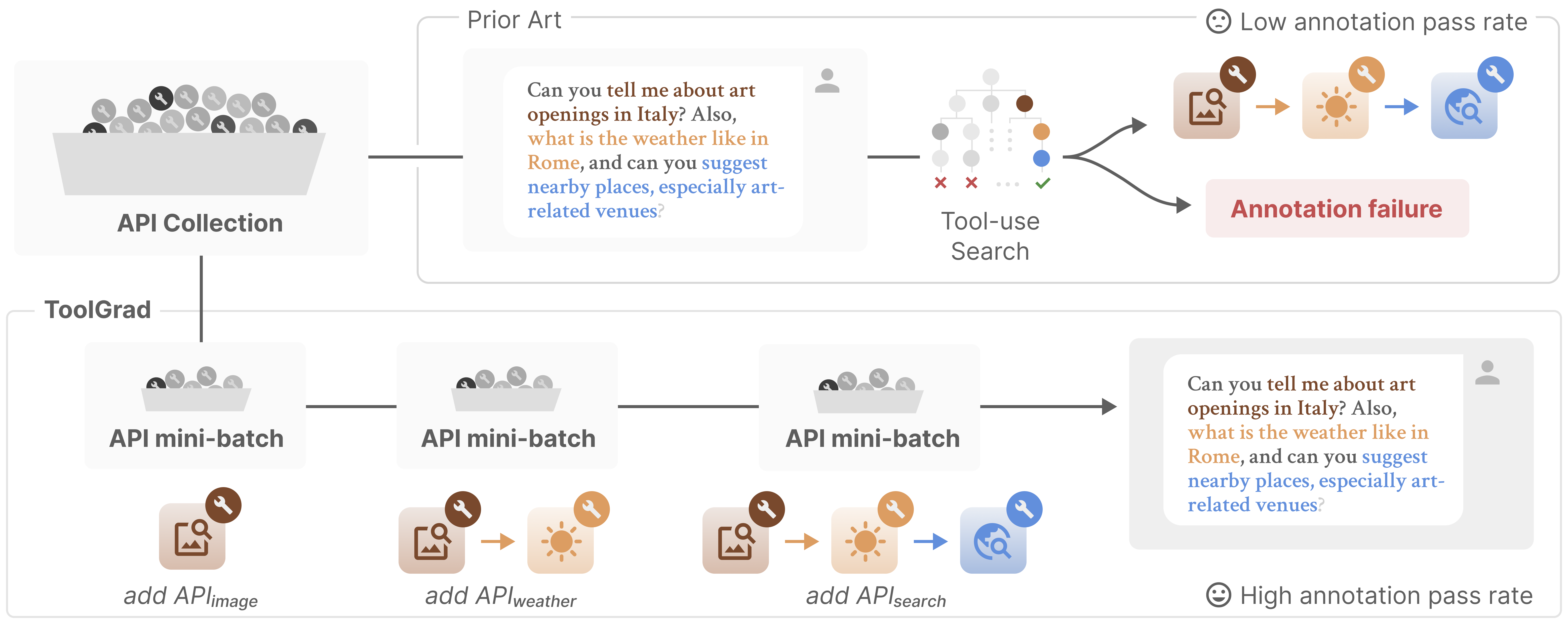
Google ToolGrad generates tool-use datasets by writing answers before queries
Google researchers present ToolGrad, a framework that reverses tool-use dataset generation by first producing ground-truth tool-use chains, then annotating matching user prompts. Presented at ACL 2026, it generates longer-horizon data at lower cost than search-based baselines like ToolBench and ToolACE, and models trained on it match proprietary LLMs on out-of-distribution, unseen-tool datasets.
Sources and evidence
Attributed quotes
“ToolGrad first generates a ground-truth tool-use chain and then annotates its corresponding user prompt.”
“LLMs trained on our generated data also outperform those trained on baseline methods, and even match SoTA proprietary LLMs on out-of-distribution (OOD) datasets with unseen tools.”
Summary last validated Sep 11, 2026
Reader actions
Report an issue
Use this for an incorrect summary, wrong source, duplicate story, or wrong category. Submissions are private and do not change the story automatically.
Related coverage
- research
NIST Study Maps How Toxic Adulterants in Fentanyl Vary Across US
NIST researchers analyzed fentanyl samples nationwide and found that the toxic substances mixed into the drug vary by region and shift over time. The study aims to help first responders and law enforcement identify dangerous adulterants in local supplies, which the agency says can help save lives.
- research
Apple Introduces Normalizing Trajectory Models for Few-Step Generation
Apple researchers introduced Normalizing Trajectory Models (NTM), which model each reverse diffusion step as an expressive conditional normalizing flow with exact likelihood training. NTM combines shallow invertible blocks per step with a deep parallel architecture, addressing few-step generation without sacrificing the likelihood framework that distillation, consistency training, or adversarial methods discard.
- research
NVIDIA teaches robots to assemble GB300 tester trays
NVIDIA describes how it taught robots to assemble tester trays for its Grace Blackwell GB300 superchip, which powers AI training and inference. The work required skilled physical labor in factories worldwide. NVIDIA says the project offered lessons in robot learning, mechanical intelligence, and traditional engineering.
- industry
Google launches Playground experimental gaming platform
Google introduced Playground, a new experimental gaming platform that lets users create, play, and share custom games. The announcement appeared on Google's official blog. No further details about the platform's features, availability, or underlying technology were provided in the source.
- research
Ai2's Bolmo byte-level language model technique published in Nature
Ai2 announced that the technique behind Bolmo, its fully open byte-level language models, has been published in Nature. New checkpoints show the approach generalizes beyond the Olmo model family to other model families, according to the Allen Institute for AI.