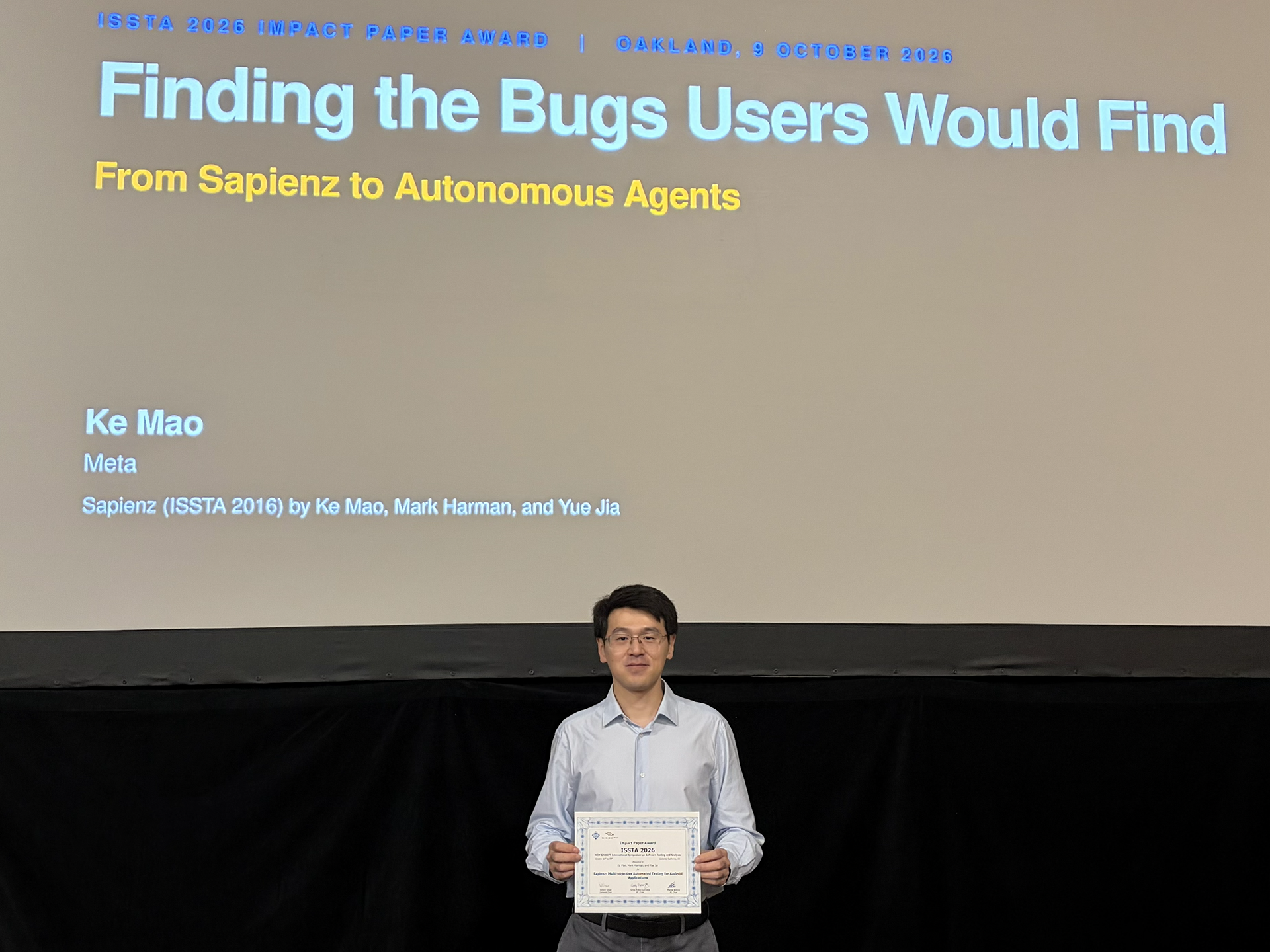
Sapienz Android testing paper wins ISSTA 2026 Impact Paper Award
Ke Mao, Mark Harman, and Yue Jia received the ACM SIGSOFT ISSTA 2026 Most Influential Paper Award for their 2016 research, "Sapienz: multi-objective automated testing for Android applications." The work began at University College London and later influenced automated testing at Meta, according to Meta Engineering.
Sources and evidence
Summary last validated Oct 16, 2026
Reader actions
Report an issue
Use this for an incorrect summary, wrong source, duplicate story, or wrong category. Submissions are private and do not change the story automatically.
Related coverage
- research
MIT and Boston Children's Hospital develop symmetry-aware AI for fetal ultrasound
Researchers at MIT and Boston Children's Hospital developed a model that teaches AI about symmetry to adjust fetal ultrasound scans on the fly, tracking fetal movement during imaging. The approach aims to make prenatal diagnosis more reliable and could spare families repeat hospital visits when scans are inconclusive.
- research
Meta details GenRecs tokenization for generative ads recommendation
Meta published an engineering post on GenRecs Tokenization, the data representation layer behind its Generative Recommenders for ads. Meta says the system shifts from scoring every ad to reasoning over ad content and user preferences using LLM world knowledge, with a stable model vocabulary intended to make ad matching more precise and compound gains for advertisers.
- agents
Meta details thin orchestrator architecture for more reliable data pipeline AI agents
Meta published an engineering post describing a "thin orchestrator" design for its data pipeline AI agents. The orchestration layer routes work and enforces reliability checks, while specialized agents handle domain reasoning. Meta says keeping the router deliberately thin produced notable improvements in efficiency and accuracy.
- infrastructure
Meta completes first phase of Prometheus gigawatt-scale supercluster
Meta said the first phase of Prometheus, its gigawatt-scale AI supercluster, is complete, and it is working to scale the cluster to roughly 1 million GPUs. The company said Prometheus also uses technologies including closed-loop liquid cooling, and that the infrastructure supports its recently released Muse family of foundational models.
- research
MIT researchers give AI models 3D understanding of crystalline materials
MIT researchers published work aimed at helping AI models understand crystalline materials in three dimensions and reason about their properties. The approach targets a gap in how models represent crystal structures, which are typically described in formats that lose 3D spatial information. The research was announced by MIT News.